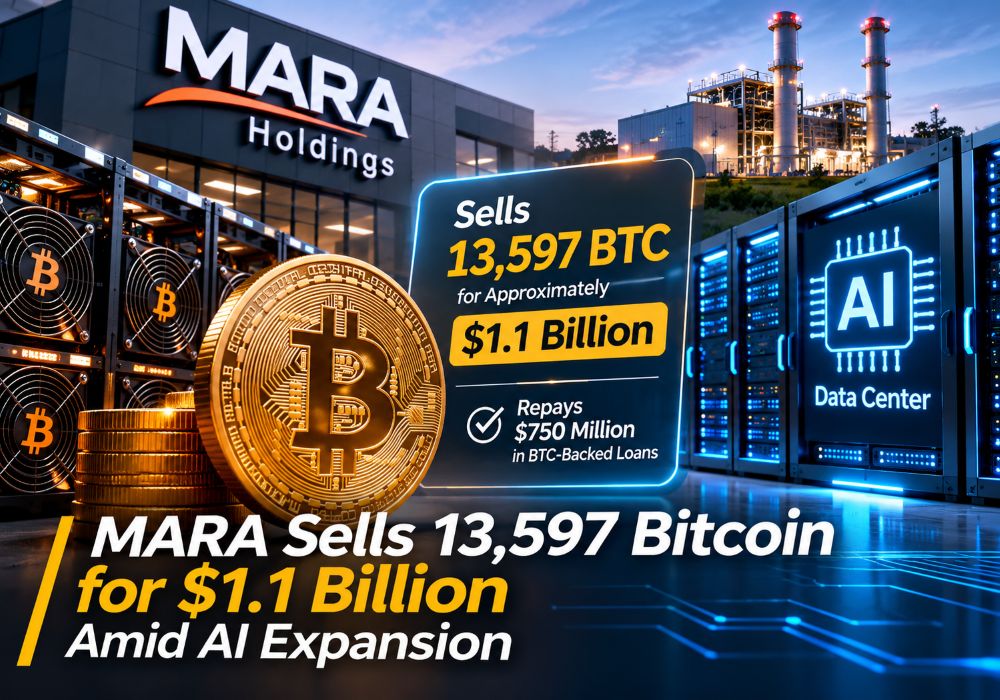


MARA Holdings, one of the largest publicly traded Bitcoin mining companies, has disclosed the sale of 13,597 BTC for approximately $1.1 billion. The company used $750 million of the proceeds to repay loans backed by Bitcoin, freeing up thousands of coins previously pledged as collateral.
The sales took place after September 30, 2026, and were disclosed in MARA’s third-quarter financial report released on November 9. According to the company, the Bitcoin was sold at an average price of approximately $81,039 per BTC.
The decision comes as MARA adjusts how it manages its Bitcoin holdings while expanding into artificial intelligence (AI), high-performance computing, and data center infrastructure.
MARA Uses Bitcoin Sales to Pay Off Debt
MARA originally borrowed $750 million during the third quarter to help finance its planned acquisition of Long Ridge, a natural gas power generation business in Ohio.
The borrowing included $600 million in new financing and the refinancing of an existing $150 million credit facility.
Rather than keeping those loans outstanding, MARA sold part of its Bitcoin holdings after the quarter ended and used the proceeds to repay the debt in full.
The repayment released 17,477 BTC that had previously been pledged as collateral. These were not newly purchased coins, but Bitcoin the company already owned and had committed as security for its loans.
Following the repayment, MARA said less than 5% of its remaining Bitcoin holdings were either loaned out or pledged as collateral.
The company also reported reducing its total debt by approximately $1.4 billion, or 37%, since the beginning of 2026.
For MARA, selling Bitcoin is becoming a more flexible part of its financial strategy.
In 2025, the company began allowing sales of Bitcoin produced through its mining operations. It expanded that policy in 2026 to include Bitcoin already held on its balance sheet.
That means MARA can use its Bitcoin reserves to raise cash, reduce debt, or support business investments rather than keeping every coin it mines.
The company has indicated that additional Bitcoin sales remain possible, depending on market conditions and its financial priorities.
Bitcoin Mining Meets AI Infrastructure
While managing its Bitcoin reserves, MARA is also developing a broader business built around energy and computing infrastructure.
Bitcoin mining has given the company experience operating large facilities that require substantial electricity, cooling systems, and reliable computing equipment.
Those capabilities have become increasingly relevant as demand grows for data centers supporting AI and high-performance computing (HPC).
One project under development involves Long Ridge. The facility includes a natural gas power plant and land that could support a large data center campus.
MARA received approval from the U.S. Federal Energy Regulatory Commission (FERC) for the planned acquisition after the third quarter ended. However, the transaction had not yet closed when the company released its November 9 report.
MARA expects to complete the acquisition before the end of 2026, subject to the remaining conditions.
The company is also expanding its computing services through Exaion, its majority-owned subsidiary specializing in cloud infrastructure and GPU-based computing.
According to MARA, Exaion has signed a four-year contract worth $79 million to provide GPU computing capacity to a customer.
These developments show how MARA is looking beyond revenue from Bitcoin mining alone. Its longer-term strategy includes providing computing infrastructure and services to businesses that need large amounts of processing power.
Still, MARA is not abandoning Bitcoin mining. The company continues to describe mining as a core business that supports its wider infrastructure operations.
Whether the expansion delivers consistent revenue will depend on completing projects, securing customers, and operating the new facilities successfully.
Revenue Falls Despite Higher Bitcoin Production
MARA’s third-quarter financial results offer another perspective on the company’s changing strategy.
Revenue fell approximately 35% to $164.2 million, compared with $252.4 million in the same quarter of 2025.
Interestingly, the company actually mined more Bitcoin during the quarter.
MARA produced 2,247 BTC in the third quarter of 2026, up from 2,144 BTC a year earlier. However, the higher production was not enough to offset the impact of lower average Bitcoin prices during the reporting period.
Despite the decline in revenue, MARA reported net income of approximately $632.1 million, compared with $123.1 million a year earlier.
That profit needs some context.
The result was largely driven by an unrealized gain of approximately $885.3 million from changes in the reported value of its Bitcoin holdings.
An unrealized gain is an accounting increase in an asset’s value. It does not necessarily mean the company received that amount in cash.
This distinction matters because financial results at companies holding substantial amounts of Bitcoin can be heavily influenced by changes in the cryptocurrency’s market value.
MARA’s latest disclosures highlight two sides of its business: the continuing role of Bitcoin mining and the growing importance of managing its assets, debt, and infrastructure investments.
The $1.1 billion Bitcoin sale has already helped the company eliminate its Bitcoin-backed term loans. Its expansion into AI infrastructure, meanwhile, remains a developing business strategy whose results will become clearer over time.
Understanding Bitcoin-Backed Loans and AI Data Centers
Two technical concepts help explain why MARA’s latest decision is important.
What is a Bitcoin-backed loan?
A Bitcoin-backed loan allows a company or individual to borrow money using Bitcoin as collateral.
Instead of selling the cryptocurrency immediately, the borrower pledges a certain amount of Bitcoin to secure the loan.
The arrangement can provide access to cash while the borrower retains ownership of the pledged assets, subject to the loan agreement.
However, there are risks. If Bitcoin’s market price falls significantly, the lender may require additional collateral or take other actions under the loan terms.
By paying off its Bitcoin-backed loans, MARA was able to release the Bitcoin it had pledged as security.
Why are Bitcoin miners interested in AI data centers?
Bitcoin mining and AI computing have different purposes, but they share some infrastructure requirements.
Both need reliable electricity, cooling systems, network connectivity, and facilities capable of handling demanding computing operations.
The hardware, however, is different.

Bitcoin mining generally uses specialized machines called Application-Specific Integrated Circuits (ASICs). These are designed to perform the calculations required for Bitcoin’s proof-of-work mining process.
AI computing commonly relies on Graphics Processing Units (GPUs) and other specialized accelerators that can handle large numbers of mathematical operations.
A Bitcoin mining ASIC cannot simply be turned into an AI processor.
For mining companies, the opportunity is largely about reusing or developing supporting infrastructure, such as electricity connections, land, cooling capacity, and data center facilities.
That explains why companies like MARA see potential in AI infrastructure while continuing to operate their Bitcoin mining businesses.
References
- MARA Holdings — November 9, 2026. Third Quarter 2026 Shareholder Letter (SEC Filing)
- MARA Holdings — November 9, 2026. Quarterly Report on Form 10-Q for the Period Ended September 30, 2026
- CoinDesk — November 10, 2026. Bitcoin Miner MARA Sold 13,597 BTC for $1.1 Billion in Six Weeks, Plans to Sell More