

Bitcoin has a supply limit of approximately 21 million coins. Unlike traditional currencies, whose issuance can be adjusted by central banks, Bitcoin follows a predefined set of rules that determines how many new coins can be created.
This limit isn’t controlled by a single organization or decided by miners. It comes from Bitcoin’s issuance schedule, which gradually reduces the number of new coins entering circulation.
Two mechanisms are central to understanding this system: block subsidies and Bitcoin halving.
How Are New Bitcoins Created?
New bitcoins are issued through mining. When a miner successfully produces a valid block, they can claim a certain amount of newly created Bitcoin.
This amount is called the block subsidy.
Bitcoin began operating in January 2009 with an initial subsidy of 50 BTC per block. Miners claim this subsidy through a special transaction called a coinbase transaction, which also allows them to collect transaction fees.
There’s an important distinction between a block subsidy and a block reward. The subsidy refers specifically to newly issued Bitcoin, while the total block reward includes the subsidy plus transaction fees.
Halving reduces the subsidy, not necessarily the miner’s total earnings.
What Happens During Bitcoin Halving?
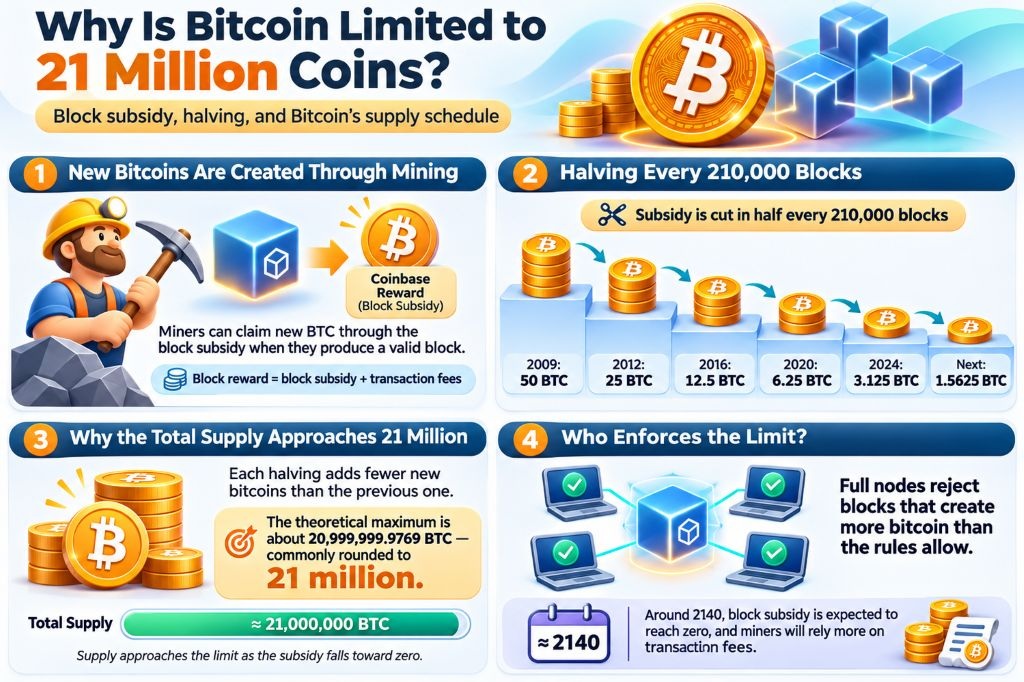
Bitcoin halving is a scheduled event that cuts the block subsidy in half.
It occurs every 210,000 blocks, approximately once every four years. The timing depends on block height, meaning a block’s position in the blockchain, rather than a fixed calendar date.
Here’s how Bitcoin’s subsidy has changed:
| Period | Starting Block | Subsidy per Block |
|---|---|---|
| 2009–2012 | 0 | 50 BTC |
| 2012–2016 | 210,000 | 25 BTC |
| 2016–2020 | 420,000 | 12.5 BTC |
| 2020–2024 | 630,000 | 6.25 BTC |
| 2024–2028 (est.) | 840,000 | 3.125 BTC |
| From around 2028 | 1,050,000 | 1.5625 BTC |
The fourth halving occurred on April 20, 2024, reducing the subsidy from 6.25 BTC to 3.125 BTC per block.
The next halving will take place at block 1,050,000, currently expected around 2028. Its exact date will depend on how quickly blocks are mined.
Where Does the 21 Million Bitcoin Limit Come From?
The 21 million figure is the mathematical result of Bitcoin’s initial subsidy and its halving schedule.
During the first 210,000-block period, the maximum subsidy totals 10.5 million BTC.
The second period adds up to 5.25 million BTC. The third contributes 2.625 million BTC, and each subsequent period allows half as much as the previous one.
Adding these progressively smaller amounts produces a total approaching 21 million BTC.
Technically, the maximum is slightly lower.
Bitcoin’s smallest unit is a satoshi, equal to 0.00000001 BTC. Since subsidies are calculated in whole satoshis, repeated halvings eventually reduce the amount to zero.
Under Bitcoin’s current subsidy rules, the theoretical maximum is 20,999,999.9769 BTC.
That’s the maximum implied by the subsidy schedule, not a guarantee that every coin can be spent. Some block subsidies have gone unclaimed, the genesis block’s reward cannot be spent, and coins may become inaccessible when private keys are lost.
Can Bitcoin’s Supply Limit Be Changed?
Bitcoin’s supply rules are enforced through network consensus.
Computers running full nodes independently verify blocks against Bitcoin’s consensus rules. If a miner attempts to create more Bitcoin than the permitted subsidy and transaction fees, nodes following the existing rules reject that block.
Technically, Bitcoin’s software can be modified. However, changing the code on one computer doesn’t change the rules accepted by everyone else.
Increasing the supply limit would require a change to the consensus rules and broad voluntary adoption of those rules by network participants.
No individual miner, developer, or organization can simply increase Bitcoin’s supply for the existing network.
What Happens When All Bitcoins Have Been Issued?
Bitcoin’s block subsidy is expected to reach zero around 2140, when the halving schedule has reduced the payment below one satoshi.
That doesn’t mean Bitcoin mining or transaction processing must stop.
Miners will still be able to earn transaction fees from payments included in their blocks. Satoshi Nakamoto described this possibility in the original 2008 Bitcoin white paper.
However, an important question remains: will transaction fees alone provide enough incentive to maintain a strong level of mining security?
The answer depends on future network activity, fee revenue, mining costs, and other conditions that cannot be predicted with certainty today.
Why the Supply Limit Matters
Bitcoin’s defining feature isn’t simply that its supply is limited. It’s that the rules governing new issuance are publicly available, predictable, and independently verifiable.
Anyone operating a full node can check whether newly created Bitcoin follows those rules.
The supply limit does not guarantee Bitcoin’s market value or protect its price from volatility. It establishes a known issuance schedule, while market demand remains uncertain.
Ultimately, the often-mentioned 21 million limit is the result of a straightforward technical design: an initial subsidy, regular halvings, and consensus rules that participants can verify for themselves.
References
- Antonopoulos, A. M., & Harding, D. A. (2023). Mastering Bitcoin: Programming the Open Blockchain (3rd ed.). O’Reilly Media. Chapter 12: Mining and Consensus.
- Bitcoin Core Developers. Bitcoin Core Source Code — validation.cpp. Function:
GetBlockSubsidy(). GitHub Repository. - Bitcoin Core Developers. Bitcoin Core Source Code — chainparams.cpp. Parameter:
nSubsidyHalvingInterval. GitHub Repository. - Bitcoin.org. Bitcoin Core Validation. Technical Documentation.
- Nakamoto, S. (2008). Bitcoin: A Peer-to-Peer Electronic Cash System. Section 6: Incentive. Original White Paper.
- Blockstream. What Is the Bitcoin Halving? Bitcoin Education.