


Bitcoin is a digital currency that operates without a central bank or payment processor. Instead of relying on a single institution to manage transactions, it uses a network of computers that follow a shared set of rules.
The idea was introduced in 2008 by Satoshi Nakamoto in a paper titled Bitcoin: A Peer-to-Peer Electronic Cash System. The goal was to create a payment system where people could transfer digital money without depending on a trusted third party.
Bitcoin achieves this through a combination of cryptography, peer-to-peer networking, blockchain, and a process called proof-of-work.
Why Was Bitcoin Created?
Digital payments existed long before Bitcoin. The challenge was making them work without a central authority.
Unlike physical cash, digital information can be copied. Without a reliable verification system, someone could attempt to spend the same digital money more than once. This is known as the double-spending problem.
Traditional payment systems address this through banks or payment providers that maintain transaction records. Bitcoin takes a different approach. Its network independently verifies transactions and maintains a shared record of which funds have already been spent.
How Do Bitcoin Transactions Work?
A Bitcoin transaction begins with a digital wallet. The wallet manages the cryptographic keys needed to authorize payments and tracks the funds its user can spend.
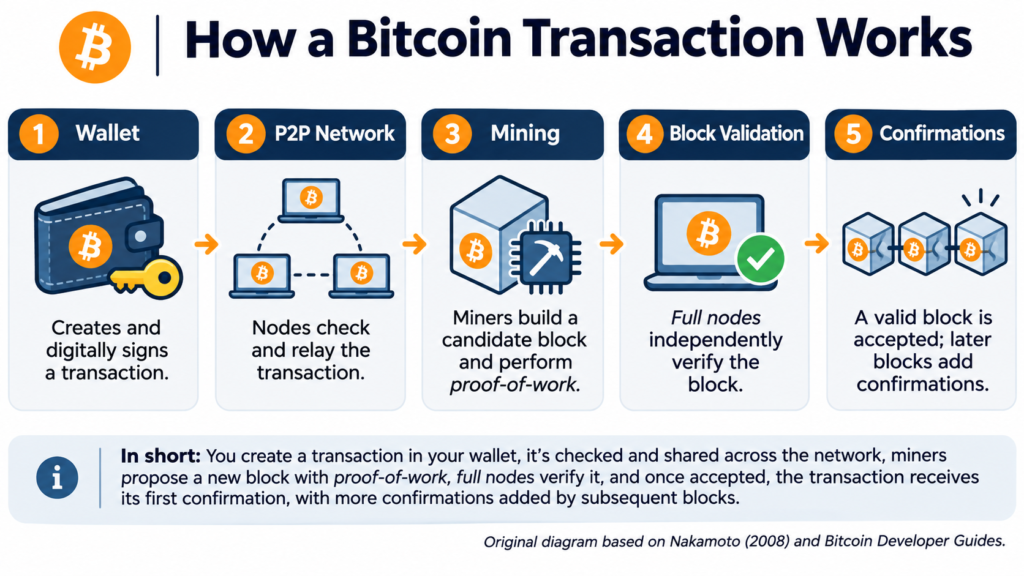
When someone sends Bitcoin, the wallet creates a transaction identifying the funds being spent and their new destination. In a self-custodial wallet, the transaction is digitally signed using the sender’s private key.
The transaction is then broadcast to Bitcoin’s peer-to-peer network. Computers known as nodes check whether it follows the network’s rules, including whether the funds being used are valid and have not already been spent.
Valid transactions can be forwarded across the network. Miners select transactions and assemble them into candidate blocks.
Once a miner produces a block with valid proof-of-work, the block is shared with other nodes. Each full node independently verifies it before accepting it into its blockchain.
A transaction receives its first confirmation when it appears in a block on the accepted chain. Additional blocks provide further confirmations, making a reversal increasingly difficult.
What Role Does Blockchain Play?
Blockchain is the public ledger that records Bitcoin transactions. Rather than storing transactions in a single database controlled by one organization, Bitcoin maintains copies of its blockchain across participating full nodes.
Transactions are grouped into blocks. Each block contains a cryptographic reference, called a hash, to the previous block. This creates a connected history of transactions.
A hash acts like a digital fingerprint. Changing the underlying data changes its hash, making unauthorized modifications detectable.
However, blockchain does not make historical records absolutely impossible to change. Rewriting confirmed transactions would require rebuilding the relevant proof-of-work and overtaking the accepted chain, which becomes increasingly difficult as more blocks are added.
This structure helps the network maintain a consistent transaction history without relying on a central administrator.
Why Does Bitcoin Need Mining?
Bitcoin mining serves two main purposes: producing new blocks and distributing newly created Bitcoin according to the protocol’s rules.
Miners compete to find a block hash that meets a specific difficulty target. This process, known as proof-of-work, requires repeated cryptographic calculations.
Finding a valid result takes computational effort, but checking it is relatively straightforward.
A successful miner can receive newly issued Bitcoin and the transaction fees included in the block. However, miners cannot simply create arbitrary amounts of Bitcoin or bypass the network’s rules. Full nodes reject blocks that fail validation.
Proof-of-work also makes attempts to rewrite transaction history expensive because an attacker would need substantial computing resources to compete with the network.
Bitcoin’s Strengths and Limitations
Bitcoin offers a different approach to digital payments, but its technical design involves several trade-offs.
| Aspect | What It Means |
|---|---|
| Decentralization | No single operator controls the Bitcoin network or its transaction ledger. |
| Transparency | Blockchain transactions are publicly accessible, although addresses do not directly reveal users’ real identities. |
| User control | Self-custodial wallets allow users to control their private keys, but losing access to those keys can mean losing access to their funds. |
| Transaction confirmation | Payments take time to confirm, and network congestion can affect fees and waiting times. |
| Energy consumption | Proof-of-work requires substantial computing power and electricity. |
Bitcoin’s transparency does not mean complete anonymity. Transaction patterns may reveal connections between addresses, and users can sometimes be identified through information outside the blockchain.
Similarly, the security of Bitcoin’s underlying protocol does not eliminate risks involving compromised wallets, lost private keys, or fraudulent transactions.
Final Thoughts
Bitcoin demonstrates how a digital payment network can operate without a central transaction administrator. Its main technological contribution is the ability to coordinate transaction verification and maintain a shared ledger among participants who do not need to trust one another.
Blockchain, cryptography, and proof-of-work each play a specific role in that system. Understanding how they work together is the starting point for understanding Bitcoin beyond its use as a digital asset.
References
- Nakamoto, S. (2008). Bitcoin: A Peer-to-Peer Electronic Cash System. Original White Paper.
- Antonopoulos, A. M., & Harding, D. A. (2023). Mastering Bitcoin: Programming the Open Blockchain (3rd ed.). O’Reilly Media. Official Book Repository.
- Narayanan, A., Bonneau, J., Felten, E., Miller, A., & Goldfeder, S. (2016). Bitcoin and Cryptocurrency Technologies: A Comprehensive Introduction. Princeton University Press. Publisher’s Website.
- Bitcoin.org. (n.d.). Bitcoin Developer Guides. Technical Documentation.